
• HOME
  • ARTIST
  • WORKS
  • PROCESS
  • EXHIBITS
  • CONTACT

Stone Carving

Picture
The processes involved in making the sculptures vary, depending the hardness of the stone and the degree to which its constituent elements adhere or lock into each other. Softer stones permit sharper chisels. Harder ones are tougher than the steel of the chisel.

Soapstone is mostly talc, hydrous magnesium silicate. It is very soft (one on Mohs scale of hardness) and easy to work. It responds quickly to the chisel and hammer, can be refined with rasps and files and wet-sands well with little effort.

Alabaster is mostly gypsum, calcium sulfate, two on Mohs scale. It is basically a salt deposit from a shallow evaporative basin. It dissolves slowly in water, so it is unsuitable for outdoor display. Use of the chisel on alabaster is not a good idea, as the rock fractures easily and bruises deeply under the blows of the chisel. The basic shape is achieved with saws, grinders and drills. Riffler rasps are used to refine the shape. The beauty of the stone is revealed as it is wet-sanded and then polished. Alabaster is, in some cases, quite translucent. 


Picture
Limestone, three on Mohs scale, is mainly calcium carbonate from the detritus of sea life, deposited on sea beds. It can be chiseled and ground. I generally approach it first with a diamond, hardness 10, saw. I cut parallel lines into the surface at a depth equal to the space between the lines. I then use an air hammer to knock out the material between the saw cuts. I keep going in this way until close to the desired shape, at which point I begin cross hatching shallow saw cuts without using the hammer. I then proceed with grinders and sometimes riffler files. I use rifflers on Indiana limestone more often than on the Columbus, or Kelleys Island, limestone because the small fossil elements that make up that stone are cemented together less well. The rifflers become dull much more quickly on the Kelleys Island stone. One could think of the Indiana stone as being softer, although its elements are equally hard. Water passes through it more quickly. The refining of the surface is done with abrasive bricks, pieces of silicon carbide hones or grinding wheels. I begin with coarse bricks and continue with finer and finer ones as the surface becomes smoother. The polishing process continues with paper in ascending grits, up to 2000 grit from 40.  All of this refining and finishing takes place with water running across the surface to lubricate the cutting action of the abrasives and to wash away the “dust”. Paradoxically, the entire polishing process involves putting ever more numerous, smaller and smaller cuts into the stone. The surface is then closed over by final buffing and polishing. I seal the limestone with silicones and wax. 


Picture
Marble, finds its origin in limestone but is metamorphosed through heat, pressure and time to become a material that is more or less crystalline. The spaces in between the particles in limestone are filled up by crystal growth in marble. Water does not pass through it. As it is made of the same stuff as limestone, it also three on the hardness scale. But is much more difficult to work. I often have to sharpen my diamond saws on sandstone because the blades glaze over when they are being used on the marble. The quartz particles in the sandstone are hard enough to free the cutting faces of the diamonds from their metal matrix. I use the same techniques to carve the marble as I do on the limestone although I often use small diamond files. The Vermont marble crystals are sugary; Georgian marble has much larger crystals, like rock salt. The Vermont marble is easier to carve. The crystals in Georgian marble permit the eye to enter the stone.


Picture
The erratics that I carve are granitic and have often undergone some metamorphism. Gneisses mix in with more homogenous areas of crystal growth. Stone from earlier eras is swallowed up or engulfed by subsequent magma movement. One part of the stone sometimes forms way before another… Generally the stones come from the basement rocks of the Laurentian Mountains. They formed deep beneath the surface, then, as the overlying stone was eroded away and the weight of the crust became lighter, the basement levels were exposed to the surface. The glaciers then delivered them up to me. The time and the journey have an effect on the surfaces, which are slightly different chemically, often, from the interior of the stones. Generally the stones are made up of feldspar, hardness 6, and quartz, hardness 7. The darker stones have more metal in them and have come from deeper beneath the surface than the lighter stones. As the stones are harder than steel, which has a hardness of 5.5, steel tools simply crush against the surface. Tungsten carbide tips work on stone but would fracture if they were overly sharp. For years I used a bushing head (it looks a little like a meat tenderizer) on an air hammer to work down the surfaces of the stones. The surface crystals would eventually fracture and fall away under the repeated blows of the hammer against the bushing head. Over the last couple of decades the cost of industrial diamonds has gone down far enough that most of the heavy lifting in material removal from the stone is accomplished now with the diamond blades. I use the same parallel cut process I described when discussing the limestone. As the material is so much harder, the finishing process takes much, much longer. I think its worth it, however, to use the harder stones because of the history they have had, which can be read in them, and because of their inherently lasting qualities.


Painting

Picture
I have been painting since I was a child. Every idea, set of marks, system of formal generation that was once investigated remains in the toolbox of my mind to be pulled out later, reexamined, worked over, and built upon. The movements of my hand are rehearsed a million times. The steadiness is replaced with a slight tremor that becomes another tool in eliciting response. I intend the paintings to reflect my earlier thoughts, patterns, imagery, antecedents, contemporary culture, my understanding of human response, and my intentions of the moment and each moment during the processes I went through to generate them.

Bodies of work develop simultaneously over years.

One body of work reflects my experience of place, time, nature, phenomenon, and geological process associated with Kelleys Island but modified by a lifetime of experience in the arts.

Another visits, revisits painting as language, as a method of understanding.


Picture
Another confronts the viewer with an ordered array, or what seems ordered. Some disorientation may result for the viewer. Optical effects physically affect the viewer. The surface, rich with texture of coarsely ground pigments, or with the physical record of process, offers an anchor. The painting becomes substantial. Does the painting recede towards the light?  Or does the light advance towards the viewer? Where does the movement lead you?  There is layering of system on system, not all of which can, in one moment be embraced. Perceptual shifting occurs. More disorientation, then the engulfing of the disoriented by the embrace of the transcendent experience…, or so I hope.


Every beginning is attended by doubt, by willingness to try something different.  I am not adequately aware of a satisfactory outcome until the piece approaches a conclusion.  If the work gets away from me and the unexpected, unlooked for occurs, so much the better.  


Photography

Picture
Kelleys Island has been an endless source of information, store house of material and locus operandi for the sculpture and painting on which I spent my working life. I have walked the beaches of the island since I was able to walk. Later, at around seven, I began a lifelong exploration of the interior. In my walks short and long, I have watched tilled fields and tended vineyards turn to brush, then woods. As habitats shifted, the pheasants vanished, the coons arrived and fox. Cattle grazed over the land later home to the deer and coyote. The coyotes cry out now in the evening. The rabbits are there now as always.  Wild turkey cruise through the woods and fly high up in the trees to roost as darkness falls.


Picture
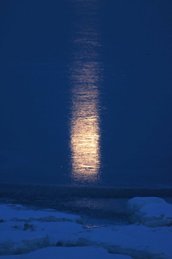
I photographed fields in the late fifties and over the years have photographed the same spots many times always finding something new. I photograph the water in the morning, then in the evening. The water is never the same, nor am I, or you. In winter the ice is magical, not static, as one might imagine, but dynamic, powerful, a churning force for light to play on.  Perhaps Kelleys Island is not a better or richer place than any numbers of others, but it is my home. If it isn’t already yours, enjoy the visit.  


For general jnformation or information about purchasing any of Mr. Herndon's artwork,Contact:
110 Laylin Lane, Kelleys Island, Ohio 43438 
Tel/FAX: 419-746-2249
E-Mail: info@charlesherndon.com

Copyright © 2011 Charles Herndon Galleries. All Rights Reserved.